
What do you do when your love bleeds out through your sleeves?
Written by Sophie Nowakowska What do you do when your love bleeds out through your sleeves?
Or when your teenage self looks back at you.
With admiration. Interest. Hesitation.
How do you forget the ones that once meant everything, and now they are gone?
Living their lives somewhere else. With someone else.
This is where Parks Sadler’s work is situated. He doesn’t see himself as a sculptor, or a
photographer, or even a transmedia artist. He works with memory, intimacy, vulnerability,
and care. With what it means to love openly. With what it means to be seen, and what it
means to leave something behind. His works do not demand. They wait. They stay gentle
and soft.
Love. Desire. Sadness. A heart that is broken and loving at the same time.

Not the Last is a carrier. The work came from a simple gesture - receiving flowers for the first
time in his life. Something small. Something rare. An appreciation of presence. Of time. Of
tenderness. The flowers he used were temporary. Beautiful at the beginning, already moving
towards decay. Sadler wanted to hold on to the moment when blooming begins to collapse.
Roses from the bouquet are preserved in resin and placed inside white bricks. The contrast
is immediate. Something delicate enclosed within something heavy. Organic forms held
inside materials made to build, secure, and protect. Bricks function as foundations, as order,
as structure, but here, they do not hold a building. They hold flowers. The arrangement
resembles a garden, but not a controlled one. The roses are not aligned. Not placed in rows.
Some appear alone, gather together, sit at the edges or at the centre. Even though the work
is constructed by the artist, it feels as if the roses have chosen their own positions.
They exist in suspension. Neither fully alive nor fully gone. Preserved, but still carrying the
memory of decay. The work stays with the feeling of being held. Of being kept. Even as the
disappearance continues.
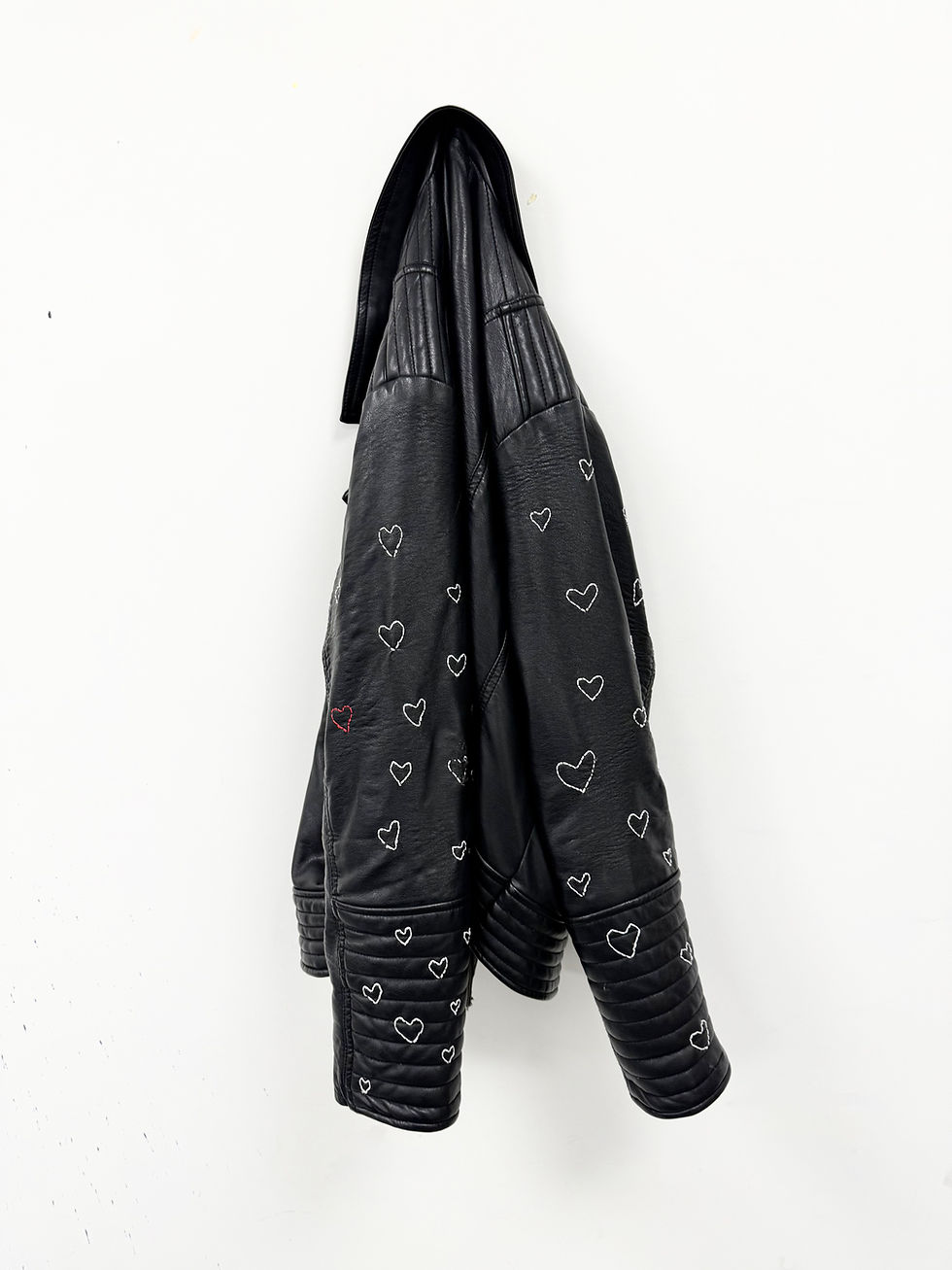
The next artwork Sadler created, How My Heart Is Worn, is also merely a carrier. A black
leather jacket he once wore to impress a partner. A piece of clothing that carried a desire to
be seen, to be adored. At first, the embroidered hearts in white and pink thread appear
decorative. But they hold something heavier - heart caught in a cycle of breaking and
healing, again and again. The jacket no longer holds a body. It holds memories. The hearts,
embroidered into leather, feel as if they are stitched directly into the artist’s skin. A needle
pierces something hard, and it obeys. Embroidery, once meant to decorate, becomes a way
to preserve pain. To make hurt visible. To keep it close.
Love. Desire. Despair. Healing. All stitched into the same surface. The hearts seem to yearn
to be noticed. To say that the wearer’s heart is open. That there is someone underneath, still
waiting to be seen.

Tie the Knot is also a carrier - a moving-image work and a return to teenage years. To
teasing. To the idea that if you can tie a knot with a cherry stem, you are a good kisser. It is
a memory of the pressure to prove oneself. To perform intimacy.
Presented as the final show concluding his residency at art’otel Hoxton, the three-screen
video loops endlessly. The memory does not stop. A desire to prove something to everyone,
now seen through the eyes of a grown man. Someone who understands intimacy differently.
Through this work, Sadler exposes himself in front of the audience. Not forcing them, but
asking to look. Letting them witness his vulnerability, bravery, sexuality, and tenderness. He
is showing a side of a man that is rarely allowed to exist publicly.
And at the end of it all, what remains is care. The artist reflects on what it means to be cared
for by society, to receive flowers as a man. How it feels like to open your heart, to tear it
open, to sew it back together, and to tear it open again. And again. And again.
These works feel like stages of becoming. Growing as a man. Not the one society expects.
Not the tough one. Not the silent one.
What stays is feeling.
What stays is the question.
What do you do when your love bleeds out through your sleeves?
In a London that still hesitates to engage with male vulnerability without irony or defence,
Sadler’s work feels necessary. He brings forward a subject rarely addressed without
spectacle or distance. The courage to be vulnerable. The bravery to be seen. The insistence
on showing intimacy not as performance, but as lived experience.
Parks Sadler is needed here. In a society where men are expected not to show their
emotions and be masculine, his work exposes these chains. He does it for those who cannot
say it out loud. For those whose hearts bleed quietly, without witnesses.


