
The Boy Who Left: Harsh Pratap Singh Bist and the Bodies That Refuse Resolution
Written by Sophie Nowakowska
What happens to the person we were before we left? Do they wait for us somewhere, behind a gate? Or do they quietly stop existing, one unfamiliar room at a time?
Harsh Pratap Singh Bist has an answer, and it isn't a comforting one. "I left the house when I was nineteen," he writes. "That boy, the one who left, he died five years later." His recent paintings read like a wake for that boy, held long after the funeral.
Born in India and based in London, Bist works across painting and sculpture. Since his 2024 Freelands Painting Prize nomination, he has shown repeatedly with LumiNoir ART, with Elephant and Vision Labs, including at Annex by Koppel Project, and at Espacio Gallery. He describes a lived duality, an Indian upbringing followed by a Western art education, that "captures an image while simultaneously fragmenting it." Bodies are rarely whole in his work. Faces don't stay put.

The series विरह (Virah) (2025 to 2026), takes its title from the Hindi word for the pain of separation from a loved one. Here the loved one is also the self. In The silence of what's missing 1 (2026), a boy sits on an older woman's lap. Her face is creased in a knowing smile. His has been smeared almost out of existence, the eyes reduced to dark hollows. The woman is remembered. The child, the one who left, won't come back into focus.

In The Funeral (2025), three robed figures stand in earth and grey, paint dripping down them like rain on a window. One is a young man staring straight out, one a child's pale head in profile, and the third has no face at all. It reads as a family portrait of one person across time: who he was, who he is, and who didn't make it.
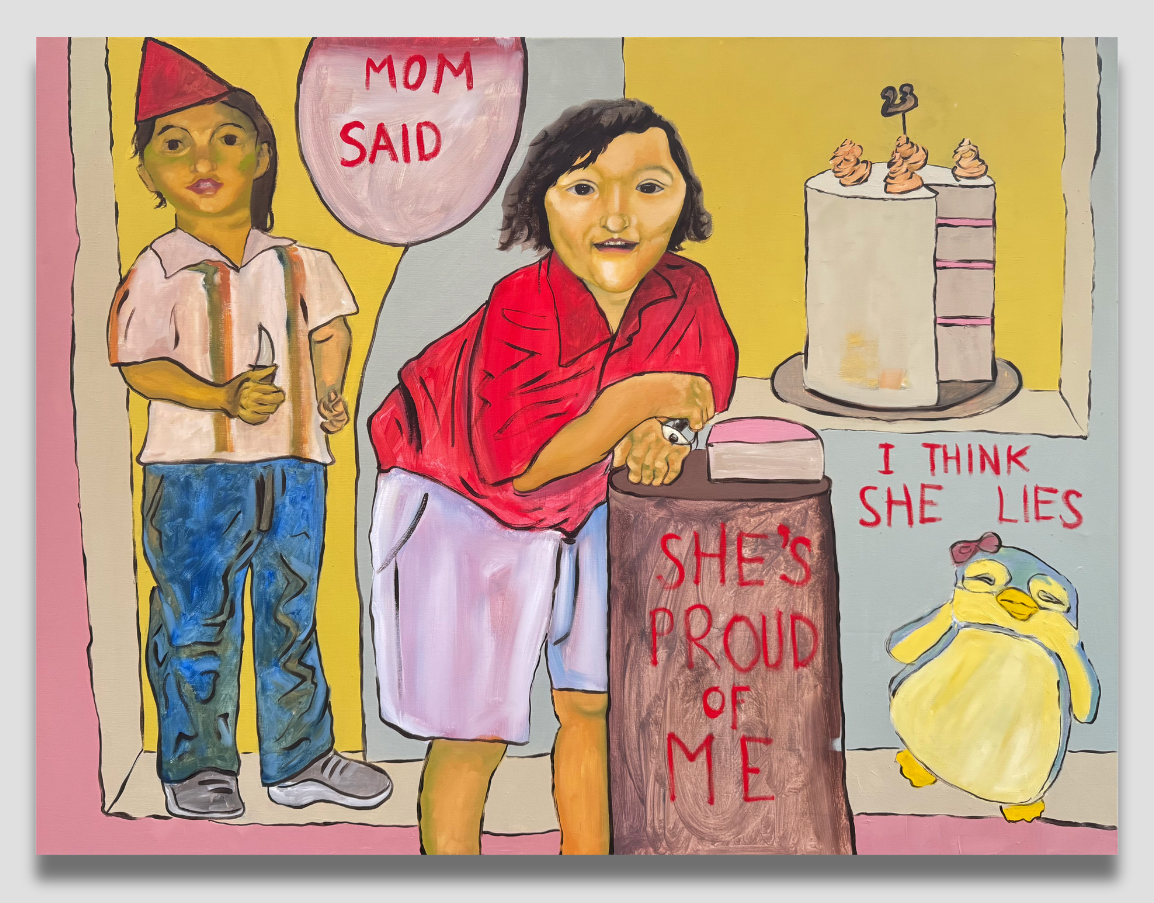
Then the tone shifts. Mom said she's proud of me / I think she lies (2025) borrows the language of a child's drawing, complete with birthday cake and scrawled words. It's funny, tender and a little brutal. There's something of Bhupen Khakhar in how naive figuration carries personal confession, but Bist's version is sharper and more self-mocking.

Since 2023, Bist has used small sculptures as models for his paintings, and wooden artist's mannequins now populate the canvases. In Playhouse (2025) they hang against a blood-red ground like puppets, one fallen to the floor. Unlike de Chirico's enigmatic mannequins, his are stand-ins for a self that has been posed, handled and put away, "stripped of vitality yet remain deeply human."

That tension between object and person is sharpest in Submission (2024 to 2025), which sets Hinduism's historically open attitudes to desire against today's guarded morality. Heavy, sculptural torsos are bound in banded stripes that recall the Mauli, the sacred thread tied at the wrist during puja. Reverence and flesh share the same frame, and neither backs down.
If I'd push him anywhere, it would be towards trusting his silences more. The erased face and the fallen mannequin say more than any painted words.

Still, few emerging painters in London hold the personal, the religious and the political together this convincingly, in a visual language this recognisable. His new video work turns directly to India's current social and political condition. Having spent years on what one person loses by leaving, he is now looking at what a country might be losing.
Bist doesn't rebuild the boy who left. He gathers the pieces "not to rebuild, but to remember." Not every body has to be put back together to be seen.


