
Measurement and the Sublime: Critical review with Brad Lay
Updated: Aug 24
Written by Chihiro Tateno
A businessman in The Little Prince claims that he “owns the stars.” He counts the stars and writes the number of them on a small piece of paper. He then locks this paper in a drawer, believing it to be a matter of “great consequence.”
One of the defining features of modernism has been the “enframing” of nature. Driven by technological and economic development, humanity has compulsively quantified the natural world, exploiting it as a source of energy and wealth. This devastating shift in our perspective has left us in a deeply strained relationship with our environment even today.
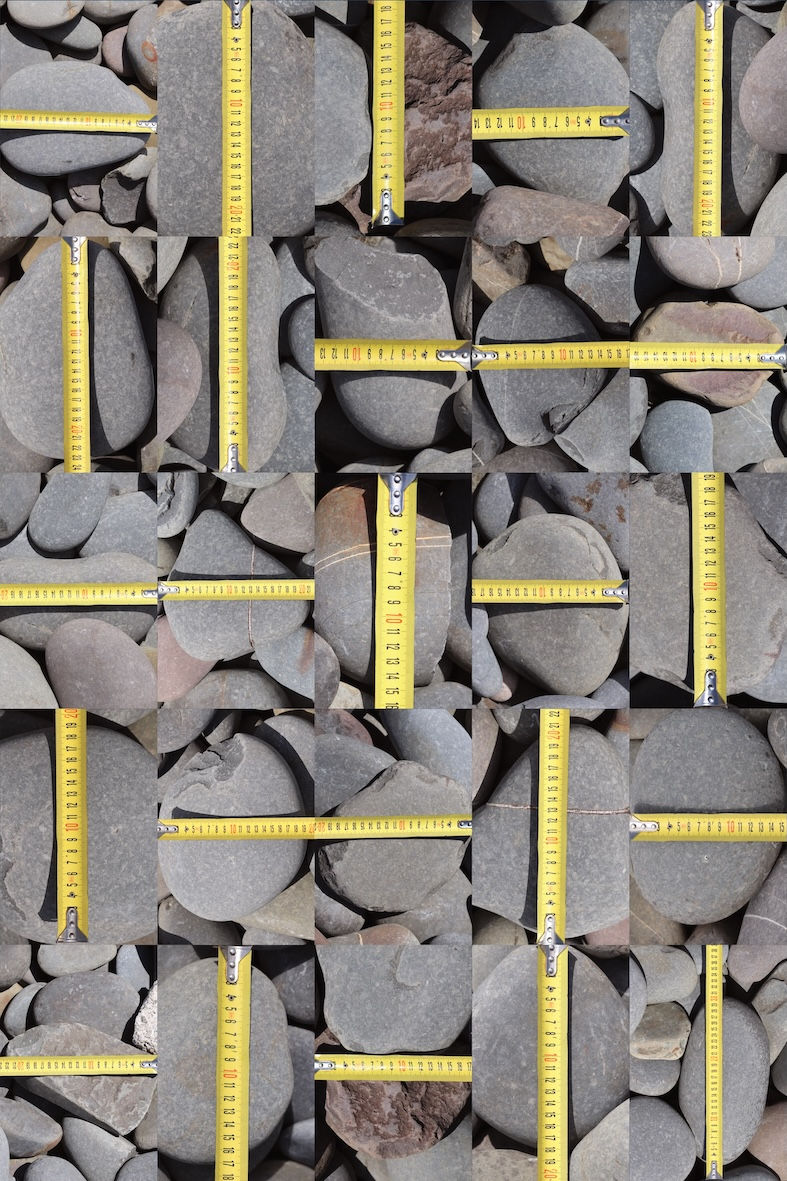
Brad Lay is an Australian artist who approaches landscapes, marine, and coastal environments in an unconventional way. His multidisciplinary practice is rooted in the awareness of our “failure to encapsulate wild environments and non-human lifeforms through images and language”. This is adequately represented in artworks such as Key Performance Indicators (Westward Ho!). In this piece, twenty-five images of steel measuring tapes placed on different stones are assembled into a single grid, creating a geometrical yet conversational visual rhythm. Nature does not attempt to impress itself upon us; it is always humans who try to measure, calculate, and compare it. The title, often shortened to “KPI” in corporate contexts, functions as a cynical hint revealing this dynamic.
From a critical perspective, it is notable that the measuring tapes are placed on top of the stones. The pebble ridge at Westward Ho! is quite low, making this looking-down angle the most natural approach for photography. However, this top-down perspective, combined with the placement of the measure over the stones, unintentionally indicates a dominance or a twisted relationship between “Measurement” and the “Sublime.” Yet, Lay’s intention remains more neutral aiming to “raise a question” around our detachment from nature rather than dictating a critique and this cohesive attitude is evident throughout his previous work.

Untitled (Wave Data), a series of artworks which was also documented as a video in 2014, exemplifies this trajectory. In this piece, Lay allowed a suspended pen to draw lines dictated by the movement and changes of sea waves. For him, photography and video function as the purest methods of documenting landscape and process. The abandonment of traditional symbolism and language in this drawing represents our clumsy, yet non-human-oriented intervention within the environment. This “visually musical” drawing enacts a new communication with nature, as if we are listening to the view and seeing the sound. Examined through the study of the distinction between language and image, this drawing possesses both linear features (representing language) and simultaneous features (inherent in images). This glitch between language and image serves as an attempt to overcome our inherent “failure” to capture the sublime, and it simultaneously gives philosophical depth to Lay’s artworks beyond solely environmental advocative practices. Although the media differ between the two artworks, there is a dedicated gaze upon the sublime and a proactive questioning of measurement and observation throughout his practice.

We obviously have “businessmen” on our planet today, still using their minuscule measures to count things vastly larger than themselves. The Little Prince ultimately walked away from his businessman. However, encountering an artwork like Key Performance Indicators (Westward Ho!) might offer these businessmen a moment of pause to stop their own counting. Human ambition to measure nature is seemingly limitless, but by abandoning the rigid straight scale and attempting to follow the incalculable waves and lines, we may be provided with a grander view one that transcends any KPI we could ever set.