
Holding the Branch with Iris Jingyi Zeng
Written by Meike Brunkhorst
Iris Jingyi Zeng is a London-based Chinese artist who holds an MA in Fine Art: Photography from Camberwell College of Art and an MDes in Communications Design from the Glasgow School of Art. They employ still photography, moving image and material experimentation to explore the relationship between subjective perception and the environment.
Zeng applies a process-led approach and develops projects over extended periods of time. Rather than using the camera merely as a tool for capturing memories for instant consumption, they place emphasis on the lasting thoughts and feelings these evoke by embracing the uncertainty of working with analogue darkroom and manual printmaking techniques. The tension between elements of chance and control is evident throughout Zeng’s practice, whether experimenting with chemical processes or deliberately manipulating materials. Considering light as the purest raw material, they revisit sites at night or shoot in low visibility conditions.

Nature is a major source of inspiration, in particular as approached from a metropolitan perspective and the role of nature in urban environments. Tapping into memories of walking in the Chinese mountains, Zeng often returns to the same woodlands in the outskirts of London, less to document the changing seasons than to witness the interplay of vegetation and human traces over time while establishing a sense of belonging rooted in spatio-temporal consciousness.

An abandoned stretch of metal fencing running through the depths of a forest is the subject of an ongoing series. The material quality of the manmade structure is mirrored in Zeng’s decision to reproduce the scene by etching the image into metal. As the process of printing, inking and reprinting is repeated, the plate gradually erodes and mimics the changing relationship between wilderness and infrastructure. Just as the actual fence is eventually reclaimed by the forces of nature, its reproduction becomes indistinguishable from its surroundings, while the mood of the scene is further determined by the change of colour from sepia to blue. The etching plate and prints are of equivalent importance, and the distinction between negative and positive image deliberately ambiguous, displayed together as lasting traces of an irreversible material history.
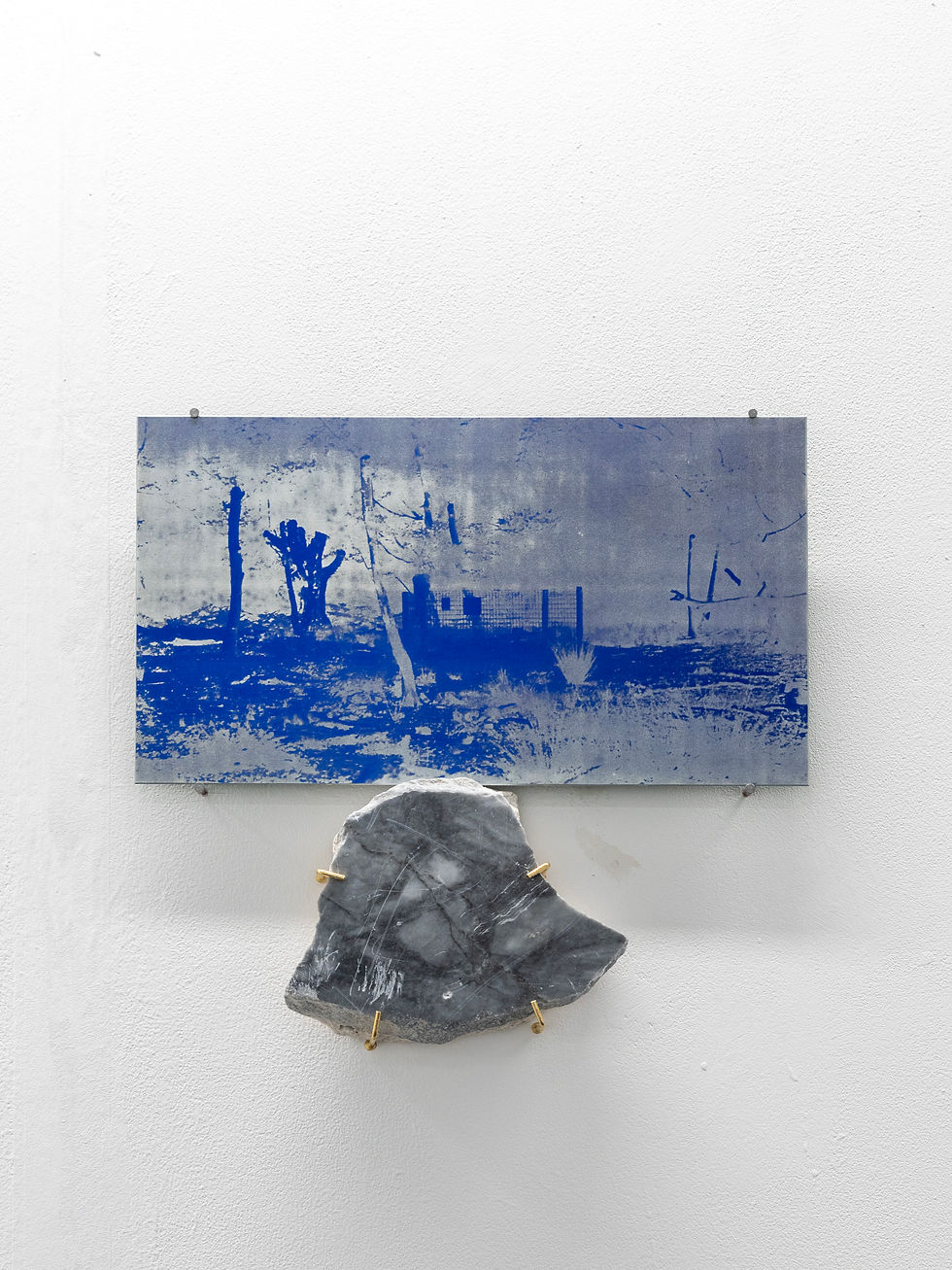
For Zeng, the physicality of the works is significant. Many of their photographs follow the shape or patterns of a found piece of wood, others are printed onto salvaged stones or found pebbles. Their subject matter relates to nature, yet without necessarily being distinctly botanical or representative of a specific place. Presented individually or grouped together, individual works adapt to their respective environment or come together in spatial installations that conjure a sense of untamed nature within a gallery setting.

When printing on paper, materiality and texture are an integral part of the work, the same negative developed, enlarged and reprinted multiple times. Prints on thick paper are allowed to curl naturally and become sculptural objects in their own right that are displayed unframed in dialogue with rocks or branches to evoke a sense of universal timelessness. Translucent images reproduced on shaped plastic are no longer passive but claim a level of autonomy as they intersect and overlap to become an active part of the creative process.

The relationship between human and nature is a major consideration and mirrored by the intricate mutually responsive relationship between layers as the image appears, disappears and reappears in reaction to chemical manipulations. Zeng draws parallels to notions of ‘strata’ as a mechanism of recognising structures in chaotic and creative potentials as described by Gilles Deleuze.
Abstracted and obscured, Iris Jingyi Zeng’s motifs are at once familiar and otherworldly. For them, the location is less important than finding familiarity and a sense of belonging in nature, as well as in the physical action of picking up objects. Conveying the essence of landscape rather than a photorealistic depiction, their works follow the tradition of Chinese landscape painting.

