
Critical review of Tiffany Foster
Written by Nigel Ip
The intersection of art history and contemporary art practice is a topic that doesn’t get explored enough, yet many great artists, particularly in portraiture like Kehinde Wiley and Catherine Opie, have demonstrated strong links to artists and mannerisms of the past. London-based American painter Tiffany Foster is among those working in this spirit, having previously trained as an art historian at the Courtauld Institute of Art, as well as working as an art teacher.

While other artists might have a unifying concept via their choice of subject matter, Foster’s practice is connected by her intimate knowledge of historic materials and techniques, citing Cennino Cennini’s The Craftsman’s Handbook and Vasari on Technique by Giorgio Vasari as valuable inspirations. She grew up training under her grandfather Raymond Heins, a notable sign painter who was based in Colorado Springs, and adopted his meticulous approach to planning compositions, producing colour studies, and continuing to refine certain painting techniques before experimenting with something different. Both artists treasure traditional forms of artmaking, with Foster expressing a disdain for digital art and its lack of tactility. One can sense a real desire to master one’s craft, a quality that is not always at the forefront of an artist’s mind these days.

Foster has a tendency to seek pictorial subjects in everyday observations. Surprise! (2025) centres on a spider at rest inside the petals of a white, night-blooming flower. A small, red moon appears ominously on the right side of the picture, creating a level of atmospheric unease. For the artist, this spider is not presented as an intruder or a predator, but as an intelligent inhabitant outside the hierarchies of meaning enforced by humanity. Instead, it perceives the world through vibrations, rather than sight.
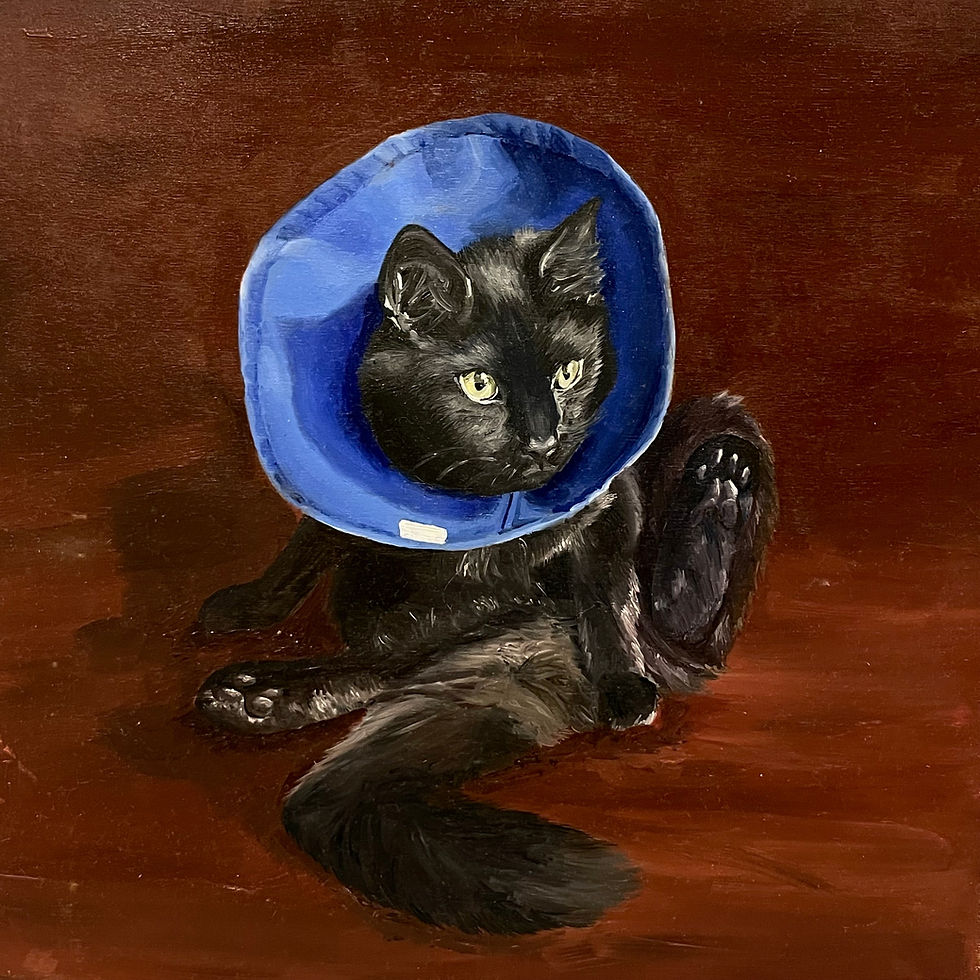
Meanwhile, Reggie (2024) depicts a candid moment when her partner’s cat, dressed in a vibrant blue cone, was caught in a silly pose. The light-hearted picture evokes the exaggerated posture and humour of early modern swagger portraits by the likes of Anthony van Dyck, as well as reframing the genre of pet portraits, which often attempt to give their sitters an air of distinction.

A graduate from the Academy of Art University in San Francisco, Foster currently describes herself as a portrait painter whose practice investigates memory, embodiment, and the emotional residue of personal history. In Sunday (2024), she homed in on her friend’s eyes and nose to accentuate the emotional rupture of a calming Sunday moment; it was based on a photograph taken during the midst of a breakup. With watery eyes and an upward glare, it suggests an aura of quiet determination to move on from a troubled situation, while exploring the contrasting tension between the visible and the withheld. The emotional weight of the picture is further accentuated by its lack of external indicators to context or setting, resulting in something that feels transparently raw and intense.
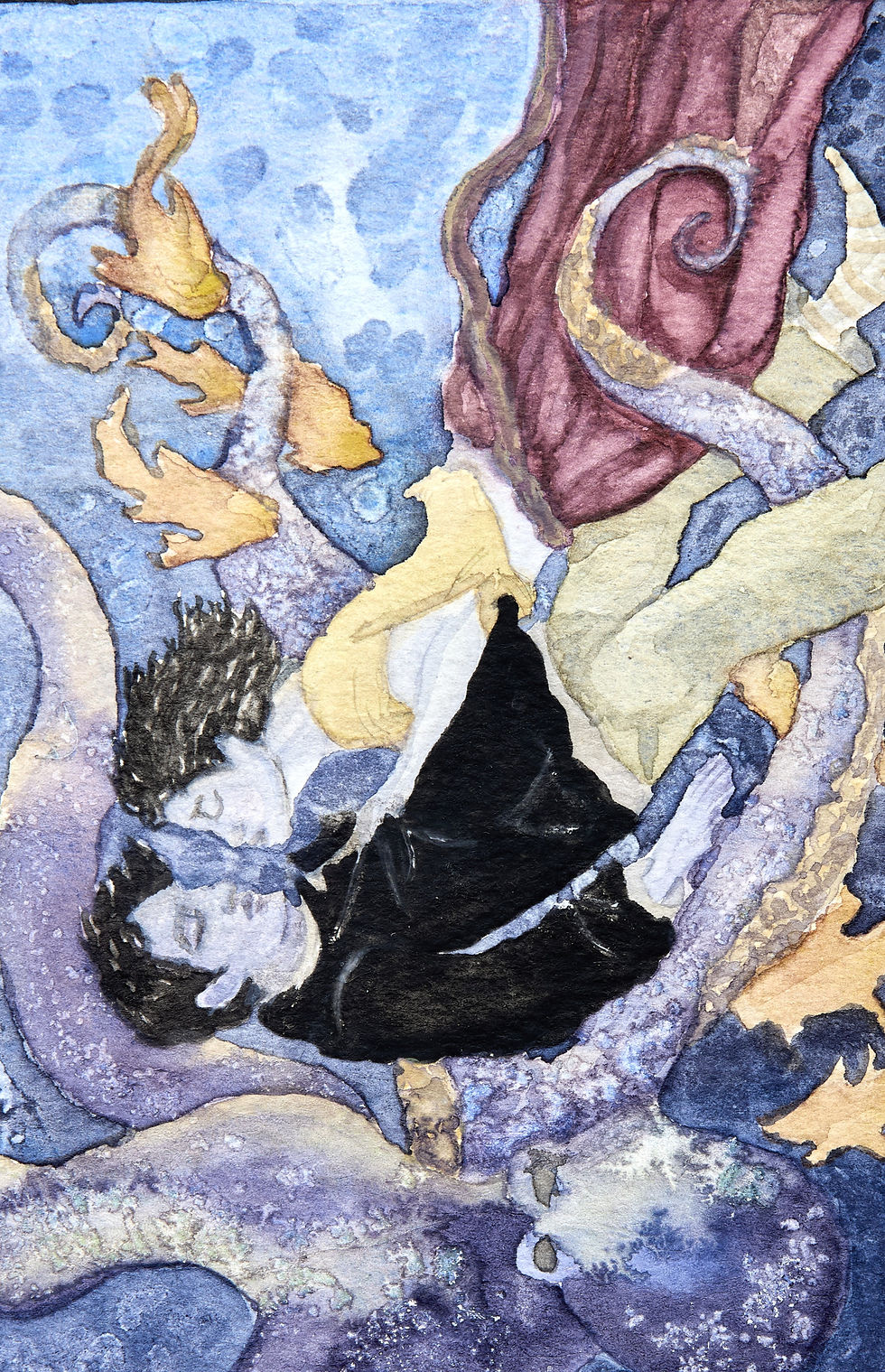
A growing concern in Foster’s practice is the exploration of fluid states of experience. Lover, Lover (2020) uses the medium of watercolour to portray two intertwining figures descending into a tidal, oceanic environment. Reminiscent of Pre-Raphaelite depictions of Paolo and Francesca from Dante Alighieri’s Inferno, Foster portrays intimacy as a state of vulnerability and transformation. Rather than resisting the current, the figures seem to surrender to it, representing the ebb and flow of the dynamics of a relationship and the greater powers at play in this journey of change.

Continuing in this discourse, Foster has recently experimented with the visual language of long exposure photography via painting, an aesthetic she associates with the blurring of the physical and the psychological. Immersion (Long Exposure) (2026) reflects on the way identity can continuously shift in relation to the presence of others. In this painting, three figures appear to absorb into each other in the picture plane, demonstrating immersion as a shared condition where individuality is not isolated, nor fixed, but shaped by external entities.
Overall, Foster’s creative practice poses deep questions about human experiences and our relationship to the world. Her paintings recognise the complexity of interpersonal relationships and the fluid dynamics of identity, memory, and states of being. Nurtured through the lens of art history and practical knowledge, her practice demonstrates a fine balance between the art of the past and the visionary potential of the future.
